




Why stay in wool sheep?
“Improving what you know delivers more value than moving to what you don’t” – Director of Agrista, John Francis
Australian Wool Innovation (AWI), has commissioned John Francis Director of Agrista, the highly respected Agricultural consultancy company, to investigate and compare various farm enterprises with wool sheep. Consider the motivations for change, whether the perceptions are real, and what the wool industry can do to retain wool growers.
Many former wool growers have changed enterprise based on perception that alternative enterprises would deliver higher profitability. The report demonstrates using comparison data that a change of enterprise is unlikely to deliver such a result, and greater profits are more likely to be derived from improving performance within an existing enterprise than moving between them.
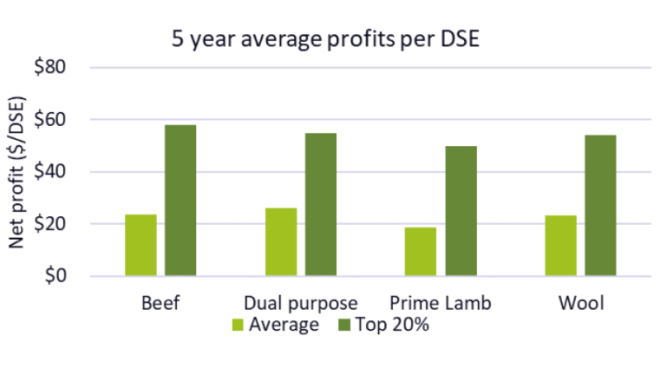
The data also shows that a specialist wool enterprise has delivered similar or superior profits when compared to alternative enterprises over a five-year period, with all experiencing big swings year on year. A specialist wool enterprise is classified as those generating 50% or more of their income from wool.
There is however a very big difference in profit within each livestock enterprise between the highest performing producers and average producers. This suggests there is far more to be gained by striving for excellence within a wool growing enterprise than delivering average performance in an alternative livestock enterprise.
Switching enterprise may seem like the simple solution to fix enterprise performance but for many managers they jump out of the frying into the fire.
There are large opportunities to improve wool flock profits even when wool prices are low, but they require a change to conventional thinking.
Wool enterprise managers can start by measuring financial and production performance to identify the greatest rewards from the lowest cost. The next step is to examine the feed supply curve and manipulate the system to align livestock energy demands over the year.
Beyond these, opportunities will typically exist to simplify operations, improve infrastructure to deliver higher levels of labour efficiency and invest in genetics to deliver significantly higher production at low marginal cost.
There is no question margins are tight in the current environment however over time wool stacks up!