




Beating drench resistance: it’s a matter of management
Effective worm control underpins profitable wool production — yet drench resistance is eroding the performance of many commonly used drenches. Recent data indicates resistance is widespread across Tasmania and growing. Consulting veterinarian, Dr Bruce Jackson, says with the right testing and management woolgrowers can slow its progression and maintain drench efficacy in their flocks.
How serious is the problem?
According to trial data from Zoetis and Virbac, seven of nine Tasmanian flocks tested showed resistance (less than 95% efficacy) to at least one drench family.
“Both black scour worm and brown stomach worm — the state’s two most economically damaging species — commonly show resistance to the major drench families benzimidazoles (BZ) or white drenches, levamisoles (LEV), and macrocyclic lactones (MLs),” Bruce noted.
“In fact, resistance to two or more drench families in the same flock is no longer unusual.”
According to Bruce, an effective drench has significant positive impacts not only on overall sheep health, but also in on wool and meat production. Using a drench with 99% efficacy versus a drench with 50% efficacy over five months can result in:
- 20% higher fleece weight
- less dag burden
- 4.7 kg heavier carcases
- 17 fewer days to finish lambs.
These numbers highlight the production and financial cost of drench resistance — not just in animal health, but in every corner of the business.
How does resistance develop?
Woolgrowers have access to a variety of drenches, often referred to as drench families. The main drench families are:
- benzimidazoles (BZ) or white drenches (e.g. Panacur, Valbazen, Oxfen)
- levamisoles (LEV) (e.g. Nilverm, Levamisole Gold)
- macrocyclic lactones (MLs) or ‘mectins’ (e.g. Ivomec, Vetmec, Cydectin)
- derquantel (STAR) (i.e. Startect, which is combined with abamectin)
- monepantel (ZOL) (i.e. Zolvix Plus, which is combined with abamectin).
Each drench ‘family’ uses a different mode of action, or ‘weapon’, to kill worms (Figure 1).
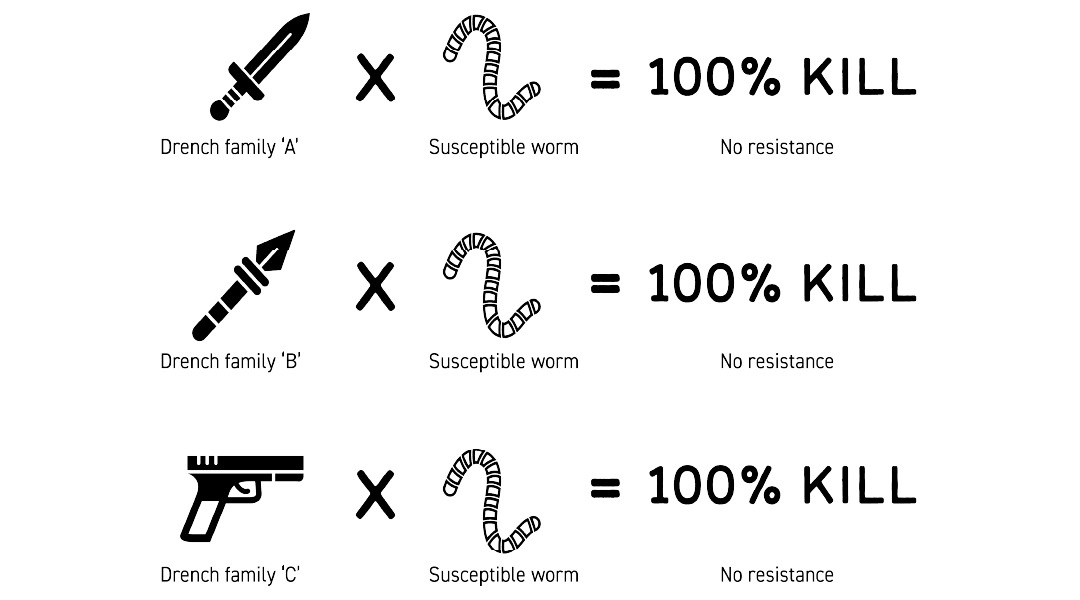
Figure 1. Understanding drench families and modes of action
When describing how drench resistance develops, Bruce uses a simple analogy.
“The inheritance of resistance in a worm population is like having an all-white flock of sheep where a ‘black sheep’ occasionally turns up,” he said.
“If you sent all the white sheep to slaughter and only kept the black sheep to breed with, you would end up with a mainly black flock.”
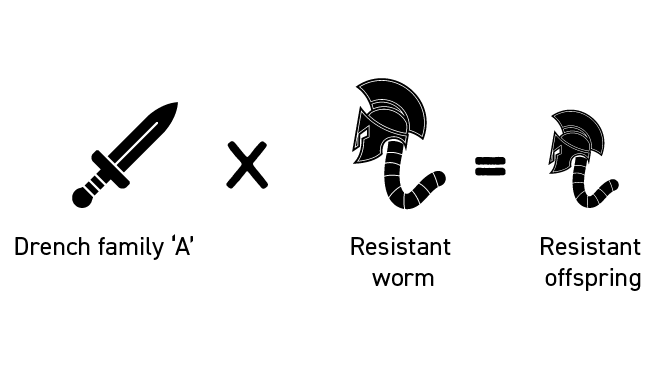
Similarly, every time we drench a mob of sheep, the susceptible worms (the ‘white’ worms if we use the above scenario) are killed, but the resistant worms (the ‘black’ worms) survive and pass their genetics on (Figure 2).
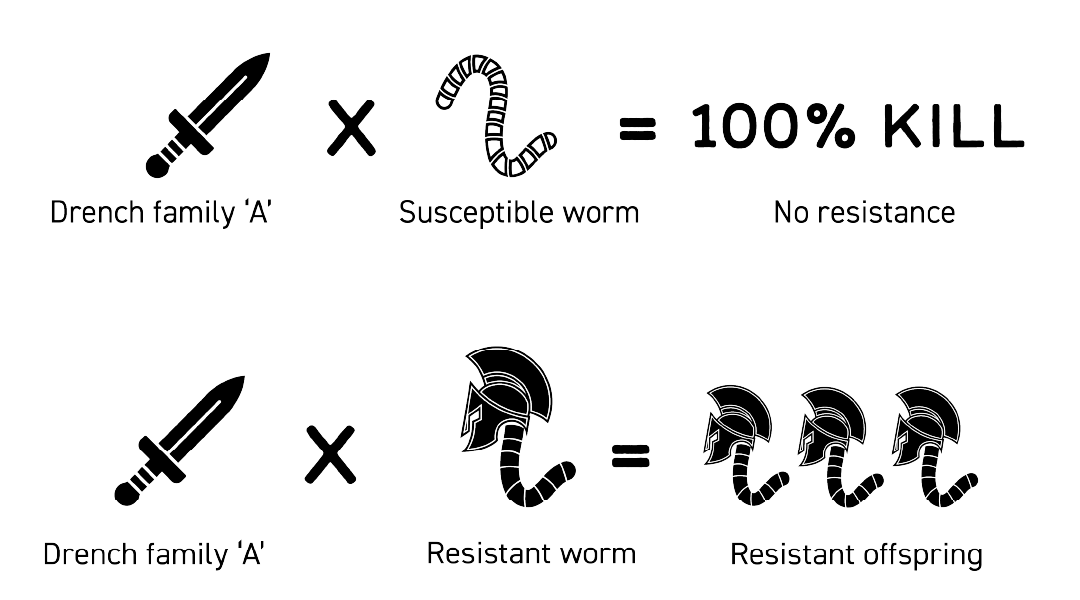
Figure 2. How resistance develops
“Over time, and especially when drenches with less than 95% efficacy are used repeatedly, resistant worms quickly dominate the population.”
Because each drench ‘family’ uses a different mode of action, or ‘weapon’, to kill worms the resistance patterns vary between them (Figure 3).
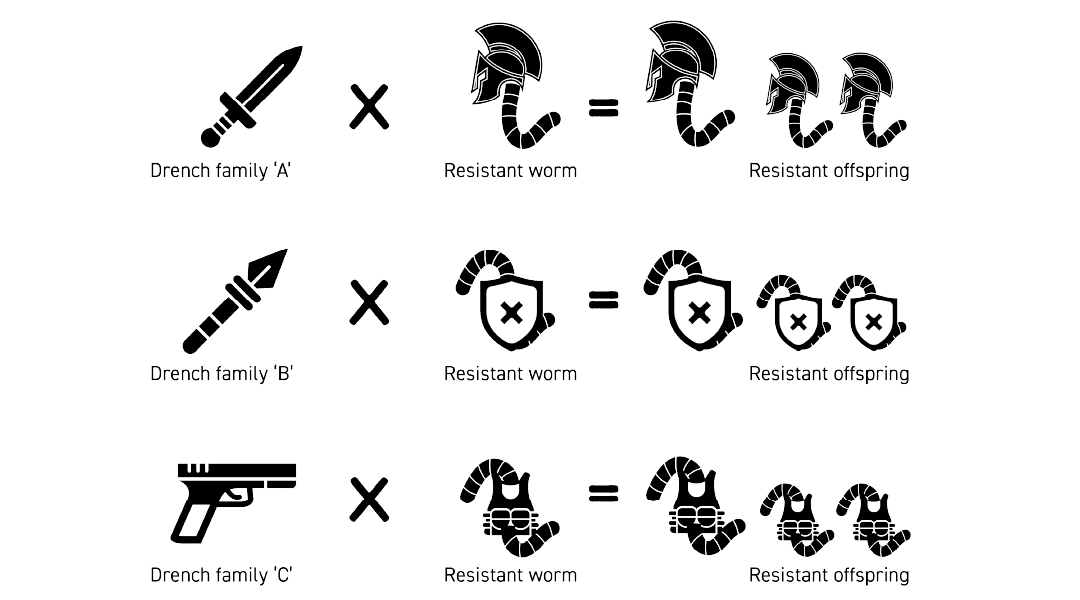
Figure 3. Different drench families — different resistance patterns
Why combination drenches work better
Rotating between drenches within a single family is an ineffective strategy to beat resistance as resistance worms already have a ‘weapon’ on hand to beat that mode of action. One of the key strategies to manage drench resistance and maintain efficacy is to use ‘combination’ drenches, which contain multiple active ingredients.
“By using multiple active ingredients at once, combination drenches require worms to carry multiple resistance genes, or weapons, to survive—a much rarer event.” Bruce explained (Figure 4).
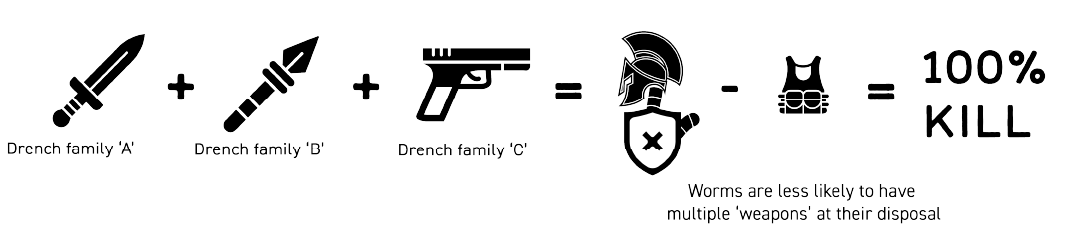
Figure 4. Why combination drenches are more effective
“Combination drenches not only improve worm control, they also slow resistance development, extending the useful life of each drench family.” (Figure 5)
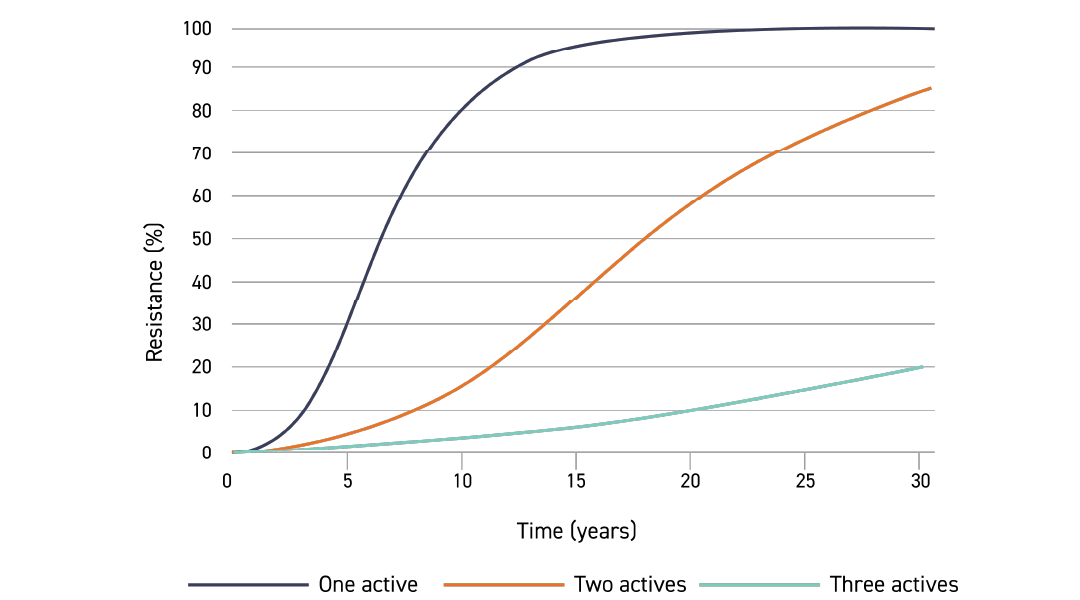
Figure 5. Resistance development over time between drench types (Source: AWI)
Drench testing: the foundation of effective worm control
Using drenches proven to work on your property is the most important action woolgrowers can take.
“Woolgrowers may be tempted to go with the most cost-effective option,” Bruce noted.
“But the most expensive drench is the one that doesn’t work.”
Woolgrowers can carry out a simple drench check, which involves”
- conducting a bulk worm egg count (WEC) before drenching
- repeating it 10 – 14 days after drenching
- identifying worm species through larval culture.
A significant egg count after drenching indicates reduced efficacy, dosing errors, or resistance.
Bruce cautions there are risks with a ‘quick and dirty’ drench check as resistance occurs on a worm species-specific basis. Different worm species also dominate at different times of the year, so Bruce recommends repeating a DrenchCheck in both summer and winter and carrying out a larval identification on a pre-drench worm test.
A more comprehensive DrenchTest’ method can be found on the WormBoss website, which compares multiple drench families at once.
“This is the gold-standard method for identifying which actives remain effective,” Bruce said.
“Both tests rely on accurate dosing, stringent sampling technique and species identification — because resistance occurs at the worm species level, not just overall egg count.”
Strategies to slow resistance
Strategic grazing: Strategic grazing offers a non-chemical tool for managing worm burdens.
“Tasmania’s climate and pasture systems mean worm larvae can survive year-round, making grazing management strategies especially important,” Bruce noted.
“Clean paddocks — typically cropped, rested, or grazed by cattle from August to December — can reduce worm burdens.
“Where ground is ploughed and the soil is disturbed, the time of year is less important.”
Bruce warns that if sheep move onto clean paddocks immediately after drenching, this can increase the proportion of resistant worms surviving in the pasture.
“The key is to use highly effective drenches (98%+) when shifting onto clean pasture,” he said.
Strategic drenching: A first-summer drench (October/November) can reduce the burden of ‘new-season’ black scour and brown stomach worms, slowing the build-up in the following year.
Selective drenching: Because 80% of worm eggs often come from 20% of animals, using eID and scales to identify slow-growing or light individuals allows producers to drench only those that need it — reducing chemical use while maintaining control.
Quarantine drenching: Drench every new introduction to the property with a four-way combination drench that includes monepantel (ZOL) or derquantel (STAR).
“This prevents resistant worms being brought onto the farm — one of the biggest risks for resistance spread,” Bruce said.
Data-based drenching strategy drives down resistance
Will Bignell, Bothwell, Tasmania joins around 7,000 ewes each year, keeping around 1,600 ewe lambs as part of a self-replacing composite flock and turning off between 5,000–6,000 stores on his irrigated fodder crops and clover-based pastures. And in what could be described as the ideal conditions for internal parasites to flourish (plenty of moisture and summer warmth), Will has yet to feel the impact of drench resistance.
Will takes a disciplined, data-backed approach to worm control, built around prevention, smart grazing and regular monitoring.
He credits improved fencing and tighter rotational grazing as the foundation of a successful grazing enterprise and effective worm-management strategy. Will and his team move sheep onto clean paddocks after drenching and he is strict about not mixing dirty and clean stock.
Lambs are often drenched onto fresh forage crops such as rape, and grazing management is designed to keep them eating up high rather than close to the ground, reducing larval intake.
“Good fencing is critical in our system to prevent re-contamination,” Will said.
“Fencing is not just infrastructure — it is the enabler of grazing pressure, pasture utilisation, parasite control and ultimately higher stocking rates and profitability.”
Monitoring is central to Will’s decision-making across all facets of his operation including worm management. He routinely conducts worm egg counts and asks his staff to collect standardised samples whenever mobs are yarded reinforcing that worm management decisions are recorded and tracked, not based on guesswork.
Will also completes an annual drench resistance test over winter to check product efficacy. So far, he reports no resistance issues — something he attributes to being proactive rather than reactive.
In terms of his drench-selection strategy, Will prefers short-acting products over long-acting ones and commonly uses combination (triple) drenches.
In his prime lamb system, he calendar-drenches during high-risk growth periods to protect average daily weight gains. His reasoning is economic: “you’re not saving any drenches and you need average daily weight gain”.
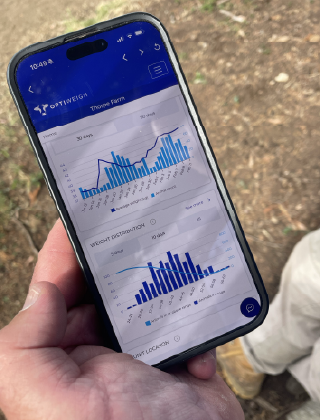
Will targets average daily weight gains of 240–300 g/day in his lambs. With lamb growth rates closely monitored through eID and Optiweigh, he can quickly identify whether performance glitches are parasite-related or caused by something else.
Overall, Will’s worm management approach blends tactical pasture management, strict biosecurity, routine monitoring and strategic drench use — aiming to protect productivity now while safeguarding drench efficacy into the future.
For more information on strategic and effective worm management:
- Visit the WormBoss website.
- Download the WormBossCombination-drench efficacy calculator here.
- Watch the Pole position: staying ahead of worms this summer webinar
- Listen to a summary of this article here.
This article has been adapted from a presentation delivered by Dr Bruce Jackson at the 2025 Red Meat Updates.