




From complexity to clarity with data-driven decision making
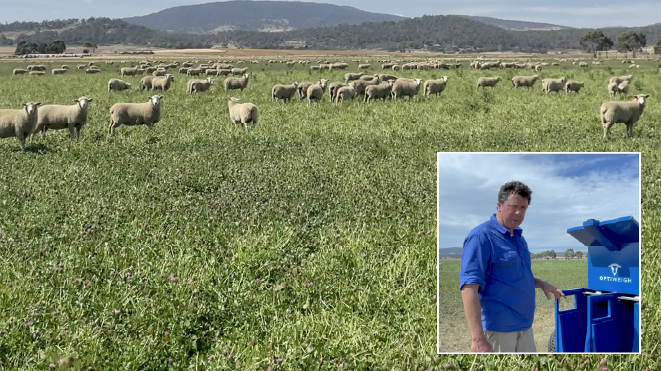
Data is a powerful tool for scaling a business — but only when it is integrated into a strategic, actionable workflow. By moving away from collecting ‘useless’ data and creating a strategic and actionable work flow based on meaningful measurement, Will Bignell, Bothwell, Tasmania has built a “big simple system” that rewards discipline, efficiency and informed decision-making.
Will is a firm believer you can’t manage what you don’t measure. Through real-time measurement and evidence-based decision making, he has transformed a complex and highly diversified farming system into a more simplified, high-performance, data-driven business.
When Will returned to his family’s seventh-generation farming business in Bothwell, during the millennium drought he was returning to a business under pressure.
At the time, the business was highly diversified and far from simple. Alongside a composite sheep enterprise within a traditional wool operation, the business had expanded into venison (including Australia’s first deer farm and world-leading handling systems), sheep milking and cheese production. The family was also producing two million strawberry runners annually for delivery to Queensland growers, plus root vegetables, flour and tourism.
Diversification was driven by tight margins and seasonal pressure, as the family searched for reliable income streams. It was a highly complicated operation with multiple enterprises, different processing systems, specialised infrastructure and competing management demands. Livestock were run at relatively low intensity while labour and attention were pulled across several value-adding ventures. It was innovative and energetic, but also difficult to scale and increasingly hard to measure what was truly driving profit.
“We built the system up ourselves so we were used to it,” Will said. “But in reality it had become the classic ‘frog-in-a-pot’ case — so complicated we didn’t realise the heat building around us.”
“When we started opening the farm up to other farmers and businesses, as part of a benchmarking group, it was suddenly like, yeah, right, this is a bit over the top.”
From complexity to clarity
Will links those difficult years directly to the mindset that now underpins his approach — improving the farm’s resilience and profitability through simplification and disciplined management. He uses data to reduce guesswork and avoid getting caught out by seasonal extremes.
He credits this evidence-based approach for helping him to focus on what matters, and to build systems that stand up when conditions turn.
“Farmers are naturally strong observers, but they are often horrendous at data analysis and confirmation bias is a huge challenge,” he said.
“Without clear information the options are limited and decisions get reactive.”
But Will is the first to admit the journey to ‘useful’ data wasn’t instant.
“At the start I collected lots of data on everything I could — much of it was useless,” he said.
“I like data, coming from a data heavy PhD background with lots of stats, but data for the sake of data is always a waste of time unless you’re going to action it.”
Benchmarking with the support of a local group of farmers and an agribusiness consultant helped Will reset. Under the scrutiny of his benchmarking group, Will’s goal became a simpler, scalable system built on strong foundations — high stocking rates (whole-farm 8.5 DSE/ha, fodder rape 45 DSE/ha and irrigated clover 32 DSE/ha), aggressive pasture utilisation, supported by solid fencing, and a sheep enterprise his staff could be manage efficiently with minimal hands-on support from Will.
A step-by-step system
Will’s entry into data collection was a gradual approach, starting with electronic tags (eID) and borrowed gear until the jigsaw finally came together. His sequence was deliberate: tags first (to build the database), then the reader and indicator, then a sheep handler, then yard upgrades so the system flowed.
“I started tagging ewes early, but I had no scales and I was borrowing a wand to collect scanning data and ewe weights pre-lambing,” Will explained.
The breakthrough came when he built the workflow around the data. The aim wasn’t technology for technology’s sake. It was labour efficiency and better decisions at scale.
“Otherwise, you get all this data on a sheep, but how do you draft it out and what do you do with it?”, he said.
The combination of electronic tags and automated sheep handling and drafting technology that integrates with tag readers and scales has allowed Will to integrate “rules-based drafting” so staff don’t need to hand-class sheep or juggle paper records.
He now uses repeatable decision rules for management, including growth weights in his lambs and scanning data and weights at key times throughout the reproductive cycle and in his ewes.
According to Will, the benefits are practical — fewer yard hours, cleaner records, and decisions that can be applied consistently across large mobs.
The results speak for themselves, with a target marking percentage of 135% in his composite ewes and average daily growth rates in his lambs of 240–300 g/day.
Will also supports high conception and marking rates with selection pressure on ewes by culling on udder structure and integrity at weaning, pre-joining shearing, systematic condition scoring and nutritional support leading into a strict five-week joining, preferential grazing for ewes carrying multiple fetuses (on the basis of scanning results), early lambing (early September) and timely weaning at 14 weeks post lambing onto irrigated fodder crops and legume-based pastures.
Real-time data — seeing problems sooner, acting earlier
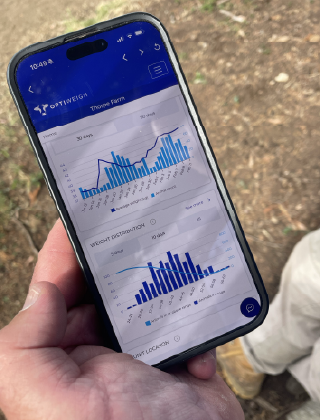
Where eID and drafting have made data actionable in the yards, the addition of real-time data collection through Optiweigh technology has brought visibility back into the paddock. Will describes it as a ‘daily check-in’.
“It is like being a dairy farmer,” he said, “You can hop up in the morning and just have a look at your phone and see what’s happening in the paddock.”
The key management impact is that real-time data is changing the speed of Will’s decision-making. Growth-rate trends can highlight water issues, feed running out sooner than expected, potential drench-resistance issues or nutritional deficiencies.
Will can see when lambs move from 240–300 g/day back below 200 g/day and ask why. This visibility allows earlier decisions about:
• moving lambs
• changing feed
• supplementing
• selling
• investigating health issues.
“You can see day-to-day immediate changes through liveweight fluctuations instead of discovering issues weeks later in the yards,” he explained.
“It reduces the lag between problem and action — turning what used to be a three-week realisation into a three-day decision.”
Will gave a recent example where average daily weight gains started to plummet and he could identify the issue, implement a strategy and see the response with minimal time in the yards off feed.
“We knew the drench was right and the feed was right, but the lambs weren’t growing. We pumped a B12 into them and they were up and going again. We could see the impact immediately. It would have taken me three weeks to see that otherwise,” Will said.
Will is quick to emphasise that analysing the data is not all about the top performers — he is focused on the middle and the tail of the mob — the animals that often get missed.
“Everyone quotes the tops — you never hear about the tail,” Will noted.
“When we introduced slower-growing first-cross lambs to the paddock, the Optiweigh records showed the drop in the mob average.
“I could then interrogate the dataset (90-day animals vs recent arrivals) to understand what was happening rather than assuming the whole mob was underperforming.”
Building capability through communication
Will also uses digital record keeping and communication tools to keep his operation consistent, which is critical given Will is based in Hobart, about an hour from the farm.
“We try and make a lot of things phone-based. For work safety, workflow, problem solving, and record keeping,” he said.
Will uses WhatsApp groups to coordinate daily tasks, share irrigation updates, send photos of pivot panels and settings, and problem-solve remotely.
“For example, a staff member will send a photo of an irrigator control panel, and we can quickly assess whether it’s set correctly without me being on-site,” he explained.
Will uses AgriWebb for spray records, drenching and animal health records, stock movements and general farm documentation. This ensures everyone is working from the same data.
He’s clear that data systems only work if people can use them, and if expectations are set from the start.
“Our job descriptions make it clear that digital record keeping is an important part of our business and everyone needs to be on the same page with this.”
For Tasmanian sheep producers Will’s story is a reminder the biggest gains come when data is built into a practical workflow. It’s not about collecting more information — it’s about collecting the right information, at the right time, and acting on it.
“You can’t change what you don’t measure.”
And when the system is right, it reduces pressure on people while lifting performance and decision confidence — exactly what Will set out to achieve when he started simplifying the business and putting measurement at the centre of management.
Find out more about precision sheep management at Precision Sheep HQ — an online platform is dedicated to sharing precision sheep management (PSM) strategies and tools, with the goal of supporting you to successfully and profitably implement PSM in your farming enterprise.
Get some insights into getting started with eID and using eID to increase profit with the following articles:
- Getting started with eID: Equipment options for livestock management
- Utilising eID data to increase profit
This article appeared in the AWI Extension TAS Newsletter March 2026. Reproduction of the article is encouraged and should be attributed as follows: This article was first published in the AWI Extension TAS Newsletter.