




Preparing your pregnant ewes for success
Getting ewe nutrition right during pregnancy is one of the most powerful ways to lift lamb survival and wool production. This article outlines practical targets for ewe condition scoring, managing nutrition and scanning for multiples, along with strategies to manage metabolic disease risk during late pregnancy and early lactation.
Key takeaways for woolgrowers
- Lamb survival is strongly driven by ewe nutrition and lamb birth weight.
- Scanning for litter size adds significant profit through targeted feeding.
- Ewes carrying multiple lambs require substantially higher energy than single-bearing ewes.
- Target condition scores for lambing:
- Singles: CS3
- Twins: CS3.3+
- Triplets: CS3.5+
- Feed gaps during late pregnancy significantly increase the risk of metabolic disease.
- Pregnancy toxaemia is gradual and energy-driven. Treat with multiple energy drenches and active rehydration.
- Hypocalcaemia is sudden and stress-related. Treat immediately with a combined calcium and magnesium injection.
- Vaccinate ewes 4–6 weeks before lambing with a 6-in-1 booster vaccination.
- Adequate nutrition and low stress improve lamb survival, wool production and future ewe fertility.
Improving ewe nutrition and managing metabolic disease risk delivers gains in both lamb survival and wool production.
Poor lamb survival remains a major constraint to breeding efficiency and productivity in wool-growing enterprises, with many losses attributable to inadequate ewe nutrition during pregnancy. But the impact extends beyond lamb survival alone.
Pregnant and lactating ewes typically produce around 20% less wool than dry ewes, and ewes that lose a lamb at birth produce about 10% less wool than their dry counterparts.
To maximise returns, focus on ewe condition, match feed supply to demand and minimise the risk of metabolic disease during late pregnancy and early lactation.
Targeted nutrition and condition scoring
Lamb survival is strongly influenced by birth weight. Optimal survival occurs between 4.5–5.5 kg, with survival declining sharply below 4 kg or above 6 kg. Ewe nutrition during pregnancy is the main driver of lamb birth weight, making accurate feed allocation essential.
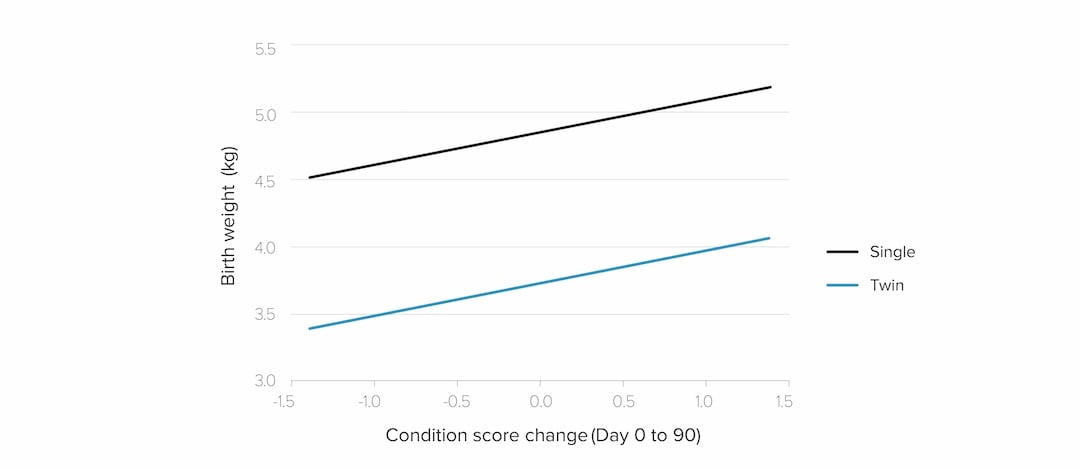
Impact of ewe condition score on lamb birth weight
Source: LifetimeWool adapted by AWI
Pregnancy scanning
Scanning 80–90 days after rams are introduced allows identification of litter size. This is critical for profitability, as scanning for multiples increases profit by an average of $5.55 per ewe, compared with $2.65 per ewe when only pregnancy status is recorded.
Knowing litter size enables targeted feeding of twin-bearing ewes, which have higher nutritional demands.
Differential feeding and condition scoring
Twin-bearing ewes require around 15% more energy during late pregnancy and 25% more during peak lactation than single-bearing ewes. Separating mobs allows feed to be directed where it delivers the greatest return.
Target ewe condition scores (CS) at lambing are:
- Singles: CS3 (avoid exceeding CS4)
- Twins: at least CS3.3
- Triplets: at least CS3.5
- Regular monitoring during pregnancy is essential to avoid ewe condition from slipping.
Feed on offer (FOO)
As a guide, mid-pregnancy requirements are 800–900 kg dry matter (DM)/ha of feed on offer (FOO) for singles and 1,000–1,200 kg DM/ha for twins. At lambing, this rises to around 1,300 kg DM/ha for singles and 1,800 kg DM/ha for twins. Early feed planning helps avoid late-pregnancy nutritional stress.
Failing to meet these high energy demands—especially during late pregnancy when 70% of a lamb's growth occurs—can cause the ewe to rapidly break down her own body reserves, leading to severe metabolic conditions.
Managing metabolic diseases
The final 4–6 weeks of pregnancy and early lactation are the highest-risk periods for metabolic disease. Pregnancy toxaemia and hypocalcaemia can appear similar but require different management.
Pregnancy toxaemia
This condition occurs when energy demand exceeds intake, forcing mobilisation of body fat and production of toxic ketones.
Key signs:
- gradual onset
- may be separated from the flock
- unresponsive when approached
- muscle weakness, staggering or lying down
- drowsy or comatose
- trembling and apparent blindness
- lying on the side for 3–4 days and dying 3–4 days later.
Prevention and treatment:
Maintain condition scores, prioritise twin-bearing ewes and ensure adequate nutrition. Minimise stress and avoid sudden feed changes.
Treatment includes glucose or dextrose injections and a glycerine glycol drench for sustained energy. If ewes are not drinking, they must be drenched with water and electrolytes to aid in their recovery.
Hypocalcaemia (milk fever)
Hypocalcaemia results from low blood calcium, often triggered by stress or periods of highest demand, particularly during the last six weeks of pregnancy and early lactation.
Common triggers:
Handling stress, yarding, shearing, cold weather, short feed gaps, lush cereal crops high in phosphorus compared to calcium, and oxalate-rich weeds such as pigweed, fat hen, soursob, dock, goosefoot (mintweed), sorrel and doublegee.
Key signs:
- sudden onset
- stiff gait or uncoordinated movement
- move or struggle when approached
- muscle trembling and weakness
- alert but may stagger or convulse
- sit down on brisket with head turned towards flank, unable to stand
- rapid collapse and possible death within 24 hours.
Prevention and treatment:
Maintain a calcium to phosphorus (Ca:P) ratio of around 2:1, reduce stress and provide appropriate mineral supplementation. Avoid grazing weeds containing oxalates.
Treatment involves a calcium-magnesium injection under the skin, with rapid recovery often seen within an hour. Repeat treatment 4–6 hourly if required. Seek professional advice if there is no improvement after treatment.
Best-practice husbandry
Minimising stress and avoiding feed disruptions in late pregnancy are critical. Avoid shearing or crutching within four weeks of lambing.
Adminisiter the annual 6-in-1 booster vaccination 4–6 weeks before lambing to ensure protection during high-risk periods.
Consider participating in an AWI and RIST Lifetime Ewe Management (LTEM) course, which provides practical, hands-on training in condition scoring and feed on offer (FOO) assessment — core skills for preventing metabolic disease and improving reproductive performance.
More information
- MMFS Chapter 10.2 Manage your ewes to improve lamb survival
- AWI and MLA The value of pregnancy scanning benefit-cost analysis fact sheet
- AWI and MLA Ewe scanning and management checklist
- AWI Extension NSW and AWI Leading Sheep webinar Part 1: Scanning: an ultra-sound investment
- AWI Extension NSW and AWI Leading Sheep webinar Part 2: I have my scanning results. What now?
- MMFS Tool 10.1 Condition scoring
- MMFS Pregnancy toxaemia fact sheet
- MMFS Hypocalcaemia fact sheet
- AWI and RIST Lifetime Ewe Management course information
- AWI and MLA Resource guide for sheep reproduction
This article has been adapted from an article written by Georgia Pugh, Project Manager, AWI Extension WA, which appeared in the AWI Woolgrower Newsletter May 2026. Reproduction of the article is encouraged and should be attributed as follows: This article was first published in the AWI Woolgrower Newsletter.